

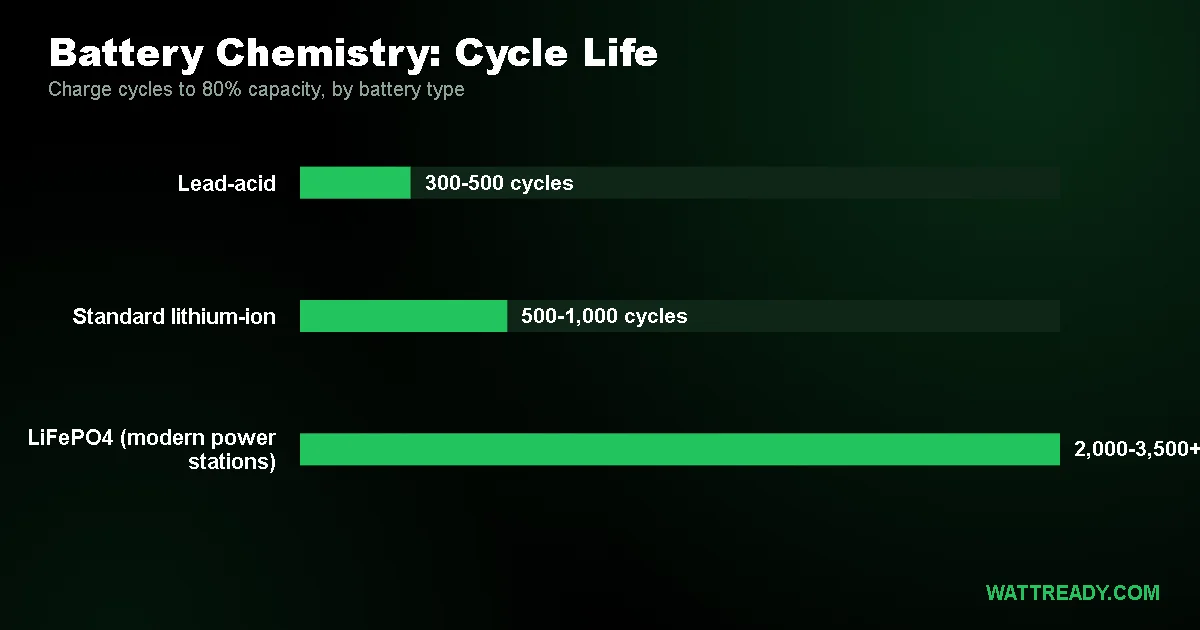
LiFePO4 (lithium iron phosphate) is already the most durable battery chemistry commonly used in power stations — but a few simple habits can meaningfully stretch that lifespan further, while some commonly repeated advice for older battery types simply doesn't apply here.
What actually helps
- Avoid full discharges when possible. Running down to 0% regularly stresses the battery more than partial discharge cycles — where practical, recharge before it's fully empty.
- Store at 40-60% charge, not full or empty, for long-term storage. If a power station will sit unused for months (off-season camping gear, a backup unit you rarely touch), a partial charge is gentler than storing it full.
- Keep it in moderate temperatures. Extreme heat (a hot car trunk, direct sun) degrades lithium batteries faster than almost any other single factor — store in a climate-moderate space when possible.
- Recharge stored units periodically. Even at rest, batteries slowly self-discharge — check and top up a long-term-stored unit every few months to avoid it drifting into a deep-discharge state.
- Use the manufacturer's charger. Mismatched chargers can cause improper charge curves that stress the cells over time.
Myths that don't apply to LiFePO4
Older nickel-based and early lithium-ion batteries suffered from "memory effect" and needed periodic full discharge-recharge cycles to stay calibrated — this does not apply to LiFePO4. You don't need to run it down intentionally, and doing so out of habit from old-battery advice slightly shortens its life rather than helping it.
What normal degradation looks like
Expect a well-maintained LiFePO4 power station to retain roughly 80% of its original capacity after 2,000-3,500+ full charge cycles — for a household using it a few times a month (not daily), that's realistically a decade or more of useful service before capacity loss becomes noticeable in daily use.
If your unit already isn't holding a charge the way it used to, start with our troubleshooting guide before assuming it's simple end-of-life degradation — a surprising number of "dead battery" cases are actually a cable, port, or temperature-lockout issue.