

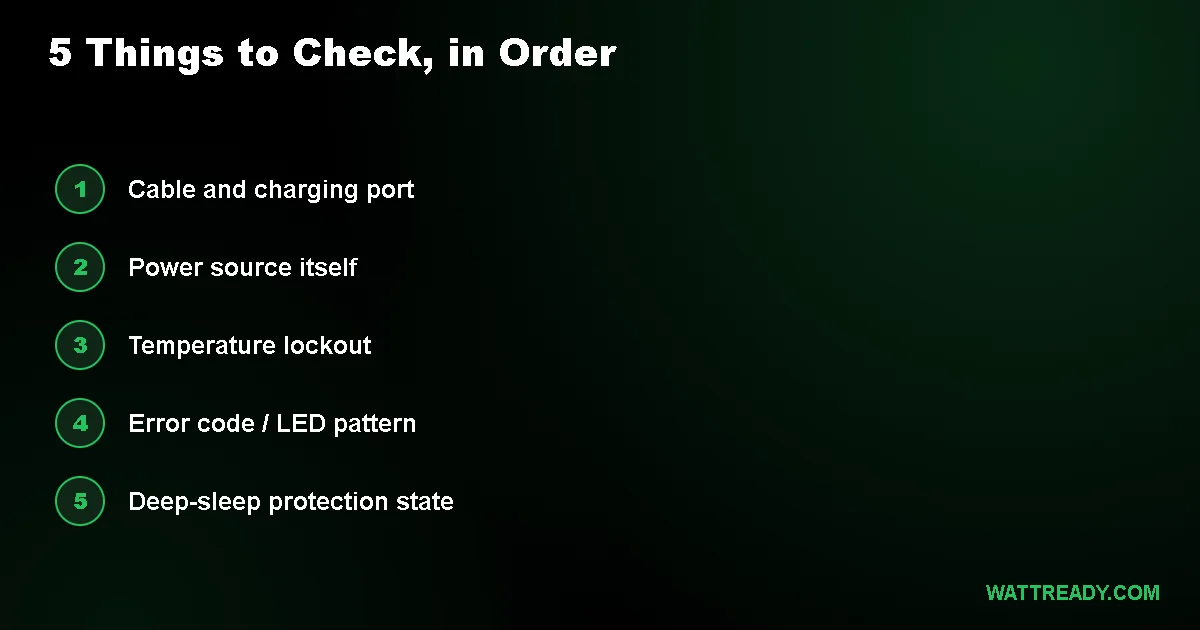
A power station that suddenly won't charge is usually not a dead battery — it's far more often one of a handful of simple, fixable issues. Work through these in order before assuming the worst.
1. Check the charging cable and port first
The single most common cause. Inspect the cable for visible damage, try a different cable if you have one, and gently check the charging port for lint or debris (unplug first). A cable that works for data but not power delivery, or a slightly bent pin, is a very common culprit that looks identical to a "dead unit" at first glance.
2. Confirm the power source is actually delivering power
Test the wall outlet, solar panel, or car socket with a different device. A tripped breaker, a solar panel in shade or at a poor angle, or a car socket that only activates with the key in a certain position are all easy to mistake for a power station fault.
3. Check for a temperature lockout
Most LiFePO4 power stations refuse to charge (a genuine safety feature, not a defect) if the internal battery temperature is outside a safe range — commonly below freezing or above about 113°F (45°C). If the unit has been sitting in a cold car or hot trunk, bring it to room temperature for 30-60 minutes and try again before assuming it's broken.
4. Look for an error code or blinking light pattern
Most units communicate faults through LED patterns or a small screen error code — check the manual (or a quick search of the model + "error code") for what the specific pattern means before contacting support; many are self-explanatory once translated (overcurrent, overtemperature, low cell voltage).
5. Check if it's in a deep-sleep / over-discharge protection state
If a power station has sat fully drained for a long time, some models enter a protective low-power state that needs a specific "wake-up" charging method (sometimes a slower trickle charge for the first 10-30 minutes before normal charging resumes, or a solid connection held for several minutes). This is covered in most manuals under a name like "battery protection" or "deep discharge recovery."
When it's time to contact support
If you've ruled out the cable, source, temperature, and error codes, and the unit still won't take a charge, this is genuinely a warranty conversation, not a DIY battery-replacement project — LiFePO4 packs are not user-serviceable, and opening the case yourself will void the warranty and introduce real safety risk. Most reputable brands (Jackery, EcoFlow, Bluetti, Anker) offer 2-5 year warranties that cover exactly this scenario.