

Charging from your car while you drive is one of the most convenient ways to keep a power station topped up on a road trip — no sun required, no campground hookup, just the engine already running. Here's how to do it correctly and what to expect.
The two ways to charge from a vehicle
12V cigarette lighter / accessory socket: the simplest option — plug the power station's included 12V car charging cable into your vehicle's socket. Most standard sockets are fused around 10-15A, which caps charging speed at roughly 120-180W regardless of your power station's max input.
Direct alternator connection (DC-to-DC charger): a more advanced setup, common in van life and overlanding builds, that taps the vehicle's battery/alternator directly through a dedicated charger (often 20-40A), delivering meaningfully faster charging than a 12V socket alone — typically requires professional or experienced DIY installation.
Realistic charging times
| Power station | 12V socket (~120W) | DC-to-DC charger (~400W, if supported) |
|---|---|---|
| 500 Wh | ~4-5 hours driving | ~1.5 hours driving |
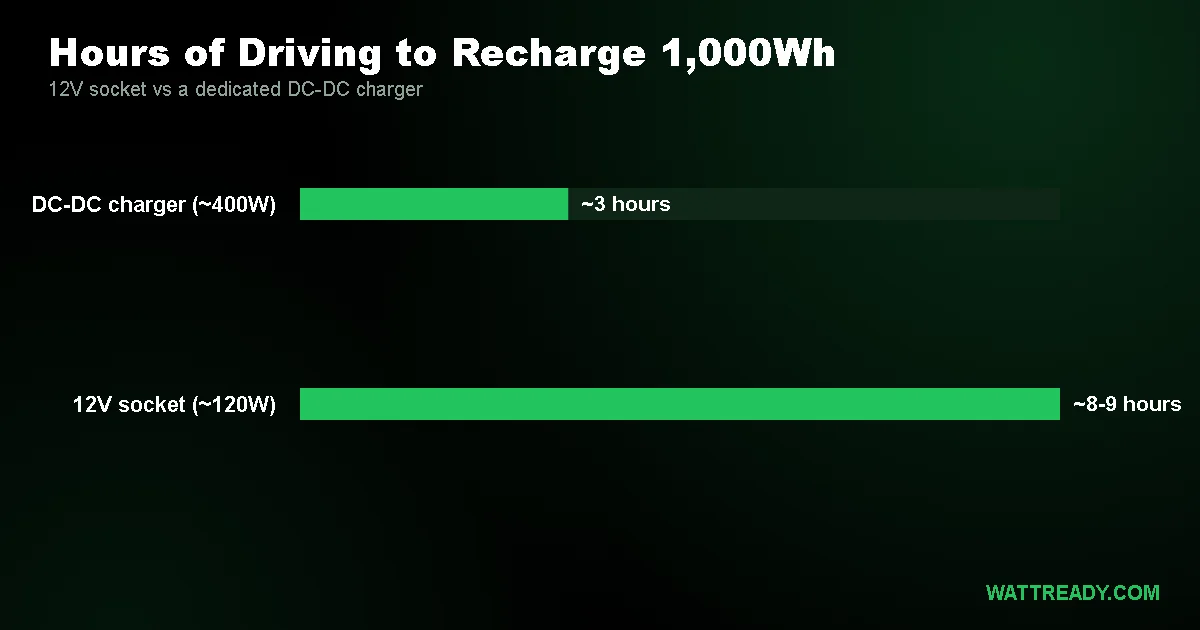
| 1,000 Wh | ~8-9 hours driving | ~3 hours driving |
| 2,000 Wh | ~16-18 hours driving | ~6 hours driving |
A standard 12V socket is genuinely useful for topping up a smaller power station across a day of driving, but it's not fast — for larger capacities or serious van life setups, a dedicated DC-to-DC charger or solar panels (see our solar charging guide) close the gap significantly faster.
Is it safe to charge while the engine is off?
Charging a power station from your 12V socket with the engine off will draw down your car's starter battery, and doing this for an extended period risks leaving you with a dead car battery. Most vehicles' accessory sockets are wired to cut off when the key is out or after a timeout specifically to prevent this — but don't rely on that behavior across all vehicles. As a rule of thumb, only charge from the 12V socket while the engine is running, or use a dedicated setup (DC-to-DC charger with low-voltage cutoff) designed for engine-off charging.