

For CPAP users, a power outage isn't just an inconvenience — untreated sleep apnea for even one night can mean poor oxygen levels, morning headaches, and daytime fatigue that matters if you're driving or working the next day. The good news: CPAP machines are one of the easiest medical devices to back up, because they draw very little power compared to almost everything else in the house.
How much power does a CPAP actually use?
| CPAP setup | Running watts | Starting watts |
|---|---|---|
| Basic CPAP, no humidifier | 30-40 W | 30-40 W |
| CPAP with heated humidifier | 60-80 W | 60-80 W |
| CPAP with heated hose + humidifier | 80-100 W | 80-100 W |
Unlike a fridge or sump pump, a CPAP has no motor to "start" — it draws roughly the same wattage the whole time it runs, which means there's no scary surge number to plan around. This makes CPAP one of the most power-station-friendly medical devices there is.
How many nights will a power station last?
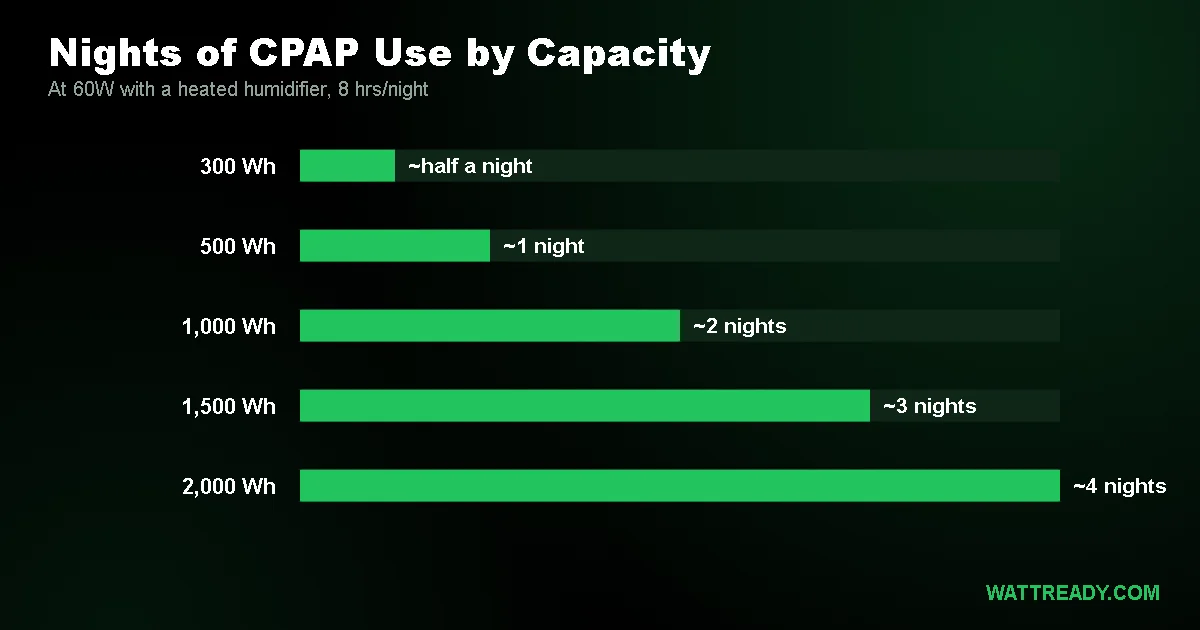
At a typical 60W (heated humidifier) draw over an 8-hour night, that's about 480Wh per night, before inverter losses. Here's what common capacities translate to:
| Power station | Nights of CPAP use (60W, 8 hrs/night) |
|---|---|
| 300 Wh | About half a night — too small on its own |
| 500 Wh | Just under 1 night |
| 1,000 Wh | About 2 nights |
| 1,500 Wh | About 3 nights |
| 2,000 Wh | About 4 nights |
If CPAP is your main or only priority, a 500-1,000Wh power station is a very reasonable, portable choice. If you're also covering a fridge or other essentials from the same unit, size up using our free wattage calculator — CPAP with and without a humidifier are both in the appliance list, so you can combine it with the rest of your household load and get one accurate number instead of guessing.
One spec to check before you buy: the inverter waveform
Nearly all modern LiFePO4 power stations produce a pure sine wave output, which is safe and clean for CPAP electronics. A small number of older or ultra-budget models use a modified sine wave inverter instead — this can cause a CPAP's internal power supply to run hotter, hum audibly, or in rare cases trigger an error. Check the product spec sheet for "pure sine wave" before buying if CPAP is a priority use case; nearly every major brand (Jackery, EcoFlow, Bluetti, Anker) uses pure sine wave across their current lineup.
If you use a separate travel battery pack marketed specifically for CPAP, it's worth comparing its price-per-watt-hour against a general-purpose power station — the general-purpose option usually gives you far more capacity and versatility (covers a fridge or lights too) for a similar or lower price.