

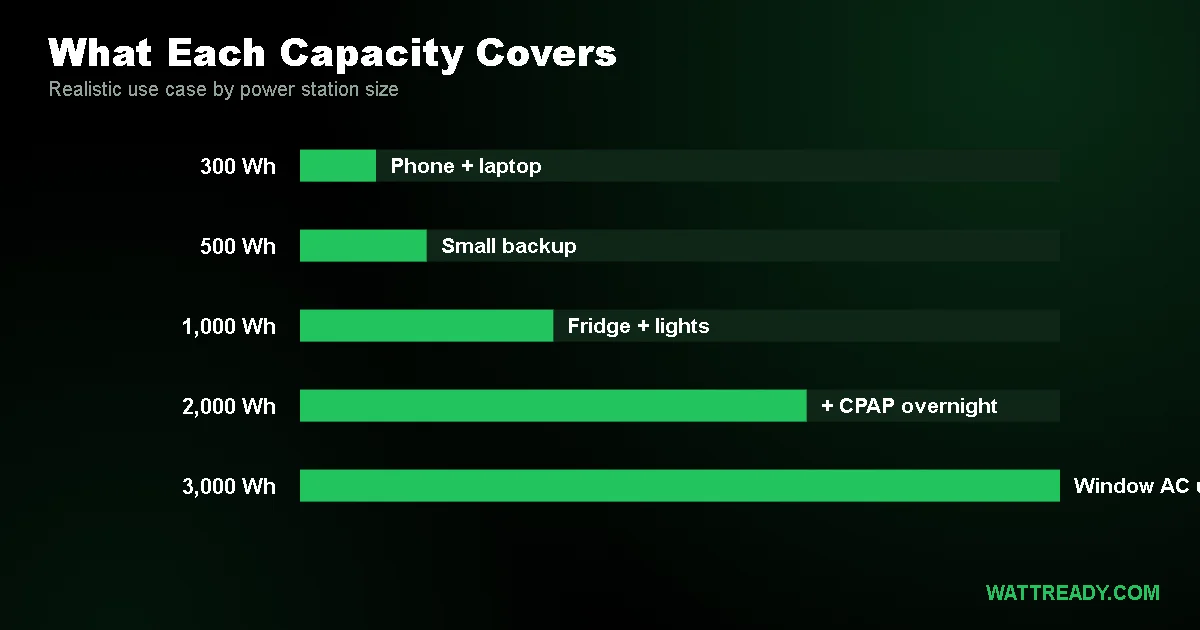
"What can this power station actually run?" is the question every buyer has and most spec sheets never answer directly. Here's what each common capacity tier realistically covers, and a free tool to check your exact appliance list.
What each capacity tier realistically covers
| Capacity | Realistic use case | Example runtime |
|---|---|---|
| 300 Wh | Phone/laptop charging, a lamp, a fan for an evening | Phone: 25+ charges; laptop: ~5 hrs |
| 500 Wh | Small backup — router, lights, phone charging through a short outage | Wi-Fi router: ~20 hrs continuous |
| 1,000 Wh | A fridge plus lights and devices through several hours of outage | Fridge (150W): ~5-6 hrs continuous run |
| 2,000 Wh | Fridge + CPAP + lights + electronics for a full overnight outage | CPAP (60W): ~28 hrs |
| 3,000 Wh+ | Multiple appliances, a window AC unit, or a full room's worth of backup | Window AC (900W): ~2.8 hrs continuous |
These figures assume the appliance runs continuously — real-world runtime is usually longer, since compressor-driven appliances like fridges and window AC units cycle on and off rather than drawing power the whole time.
Check your own appliance list
Generic tables only get you so far, because your real outage priorities are specific to your home. Our free power station wattage calculator lets you pick your exact appliances — including safety-critical ones like sump pumps and medical devices — set how many hours of backup you want, and see exactly which capacity tier covers your load with room for the starting-watts spike, not just the running total.
Why runtime estimates and reality don't always match
Three factors explain most of the gap between a spec sheet's claimed runtime and what you'll see in practice: inverter efficiency losses (roughly 10-15% of stored energy is lost converting DC battery power to AC), appliance cycling (a fridge compressor might only run 30-50% of the time), and battery age (capacity gradually declines after hundreds of charge cycles, though LiFePO4 batteries hold up far better than older lithium-ion). Budgeting a 10-15% buffer above your calculated need covers all three.