

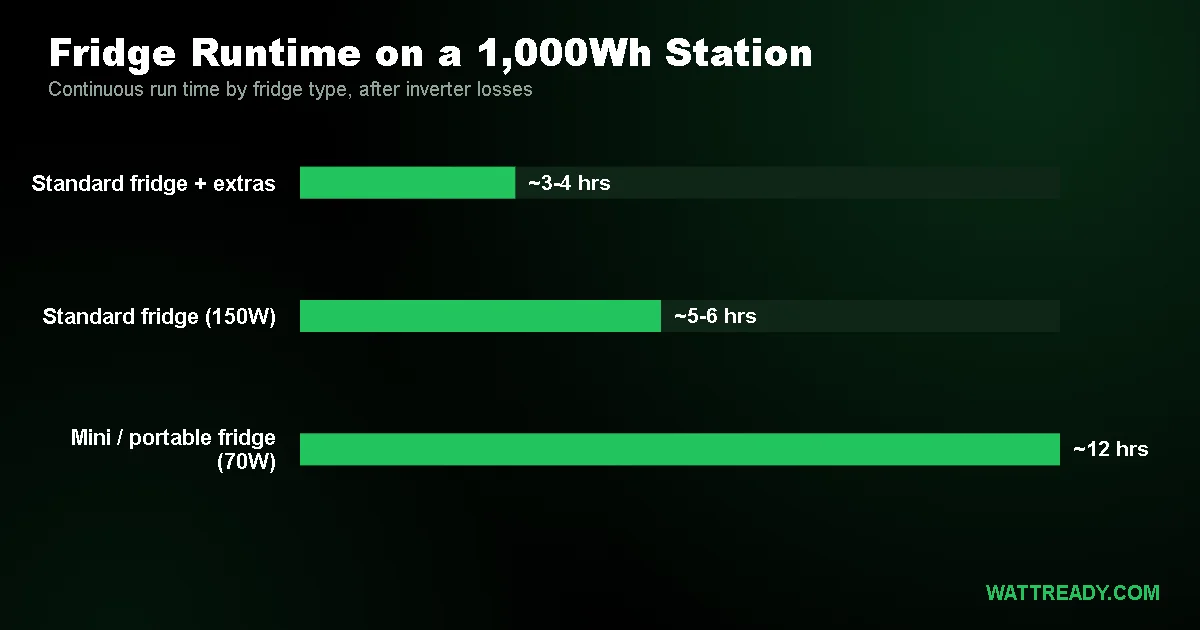
This is one of the most-searched power station questions, and the honest answer is: it depends on which fridge, and "continuous" almost never happens in real life. Here's the actual math, plus why your real-world runtime is usually longer than the number below.
The straight math
A 1,000Wh power station delivers roughly 850Wh of usable energy after typical inverter conversion losses (~15%). Divide that by your fridge's running watts to get continuous hours:
| Fridge type | Running watts | Continuous hours on 1,000Wh |
|---|---|---|
| Mini / portable fridge | 70 W | ~12 hours |
| Standard full-size fridge | 150 W | ~5.7 hours |
| Fridge + freezer combo or older unit | 250 W | ~3.4 hours |
Why real-world runtime is usually longer
Fridges don't run continuously — a compressor cycles on and off to maintain temperature, typically running 30-50% of the time in a normally-used kitchen fridge. That means a 1,000Wh station running a standard 150W fridge that cycles at 40% duty will often stretch closer to 14 hours of real elapsed time before running out, even though its "continuous" rating is under 6 hours. Ambient temperature, how often the door opens, and the fridge's age and efficiency all shift this number too.
What actually determines your number
- Fridge running watts — check the compressor's rated wattage on the nameplate (usually inside, near the bottom) rather than assuming
- Starting watts — make sure the station's surge rating clears the fridge's starting spike (often 700-1,200W), or it may shut off entirely on the first compressor cycle
- Compressor duty cycle — a newer, well-insulated fridge in a cool room runs its compressor far less than an older unit in a hot garage
- Door discipline — every door opening during an outage adds load and shortens runtime
For your exact fridge and any other appliances you want to run alongside it, our free wattage calculator gives a tailored number rather than a generic average — and checks that your station's surge rating actually covers the compressor's starting spike, which the simple math above doesn't.