

On most off-grid properties the well pump is the single largest electrical load, and it is unusual in a way that breaks ordinary sizing: it uses relatively little energy over a day but demands an enormous amount of power for a couple of seconds each time it starts. Size the system on kilowatt-hours and it will look comfortable on paper and trip every time someone runs a tap.
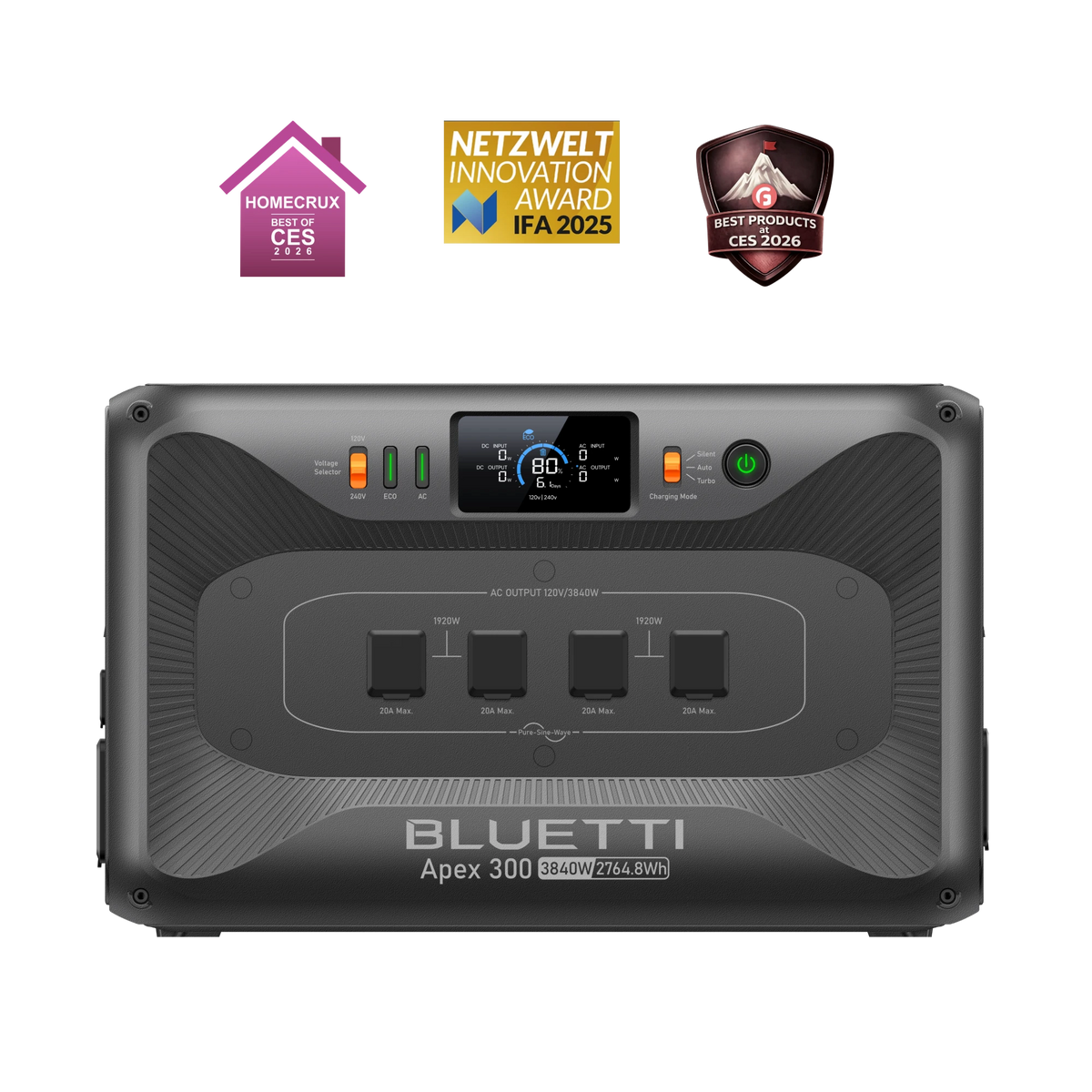
Running watts versus locked-rotor amps
A submersible pump's nameplate might read 1,000W — that is the running figure. At the instant the motor starts, before it is turning, it draws its locked-rotor current: typically three to five times running power, sometimes more on older single-phase motors.
| Pump | Running watts | Startup surge | Inverter needed |
|---|---|---|---|
| 1/2 HP shallow well | ~750 W | 2,250 – 3,750 W | 3,000 W+ |
| 3/4 HP submersible | ~1,000 W | 3,000 – 5,000 W | 4,000 W+ |
| 1 HP submersible | ~1,500 W | 4,500 – 7,500 W | 6,000 W+ |
| 1.5 HP deep well | ~2,200 W | 6,600 – 11,000 W | 8,000 W+ |
And that is the pump alone. The surge lands on top of whatever else is already running — the fridge, the lights, a laptop — so the inverter must cover the household baseline plus the full surge simultaneously.
Read inverter specifications carefully here. Manufacturers quote a surge rating alongside continuous output, but the duration matters: a unit rated for 2x surge for 100 milliseconds may not survive a two-second motor start. Look for the surge duration, not just the peak number.
Two fixes cheaper than a bigger inverter
A soft starter ramps the motor up over a second or two instead of applying full voltage instantly, typically cutting the surge by 50-70%. At $150-400 it is dramatically cheaper than the inverter and battery capacity you would otherwise need, and it reduces mechanical wear on the pump as a bonus. For off-grid properties with a well, this is close to standard practice.
A larger pressure tank attacks the problem from the other direction. A bigger tank means the pump starts less often and runs longer each time, so you get fewer surge events and better motor efficiency. Going from a 20-gallon to an 80-gallon tank can cut daily starts by half or more, for a few hundred dollars.
Together these often bring a 1 HP pump within reach of a 4,000W inverter that could not have started it otherwise.
Daily energy is the easy part
Having established that surge drives the inverter, the energy side is modest and often reassuring:
A household using 300 gallons a day with a pump delivering 10 gallons per minute runs it for about 30 minutes. At 1,000W that is 500Wh a day — less than a refrigerator. The array needed to cover it is roughly 500 ÷ (4.5 × 0.75) = 150W, a single small panel.
So the pump costs you very little in panels and battery capacity, and a great deal in inverter capability. That asymmetry is the whole design problem, and recognising it prevents overbuying the wrong component.
The alternative worth considering: a DC solar pump
Purpose-built DC solar well pumps run directly from panels with no inverter and often no battery at all, pumping whenever the sun shines into a storage tank you draw from by gravity or with a small pressure pump. No surge problem, because there is no AC motor start to survive.
The trade-offs are real: lower flow rates, the need for elevated or large storage, and generally more expensive pumps. But for a new off-grid installation where the well is being planned rather than inherited, it removes the hardest constraint in the whole system. Worth pricing before defaulting to an AC pump and a large inverter.
Practical checklist
- Find your pump's horsepower and locked-rotor amps — on the nameplate or the well documentation, not estimated
- Size the inverter for household baseline plus full pump surge, and check the surge duration rating
- Price a soft starter before pricing a larger inverter
- Consider a larger pressure tank to reduce start frequency
- For a new installation, get a quote for a DC solar pump as a comparison
- Remember the pump must still start on generator power during a long overcast stretch — size that too
Our free wattage calculator includes well pumps with their surge figures, so you can see the combined running and starting totals for your specific appliance mix. The broader homestead context is in what most homestead solar guides get wrong.