

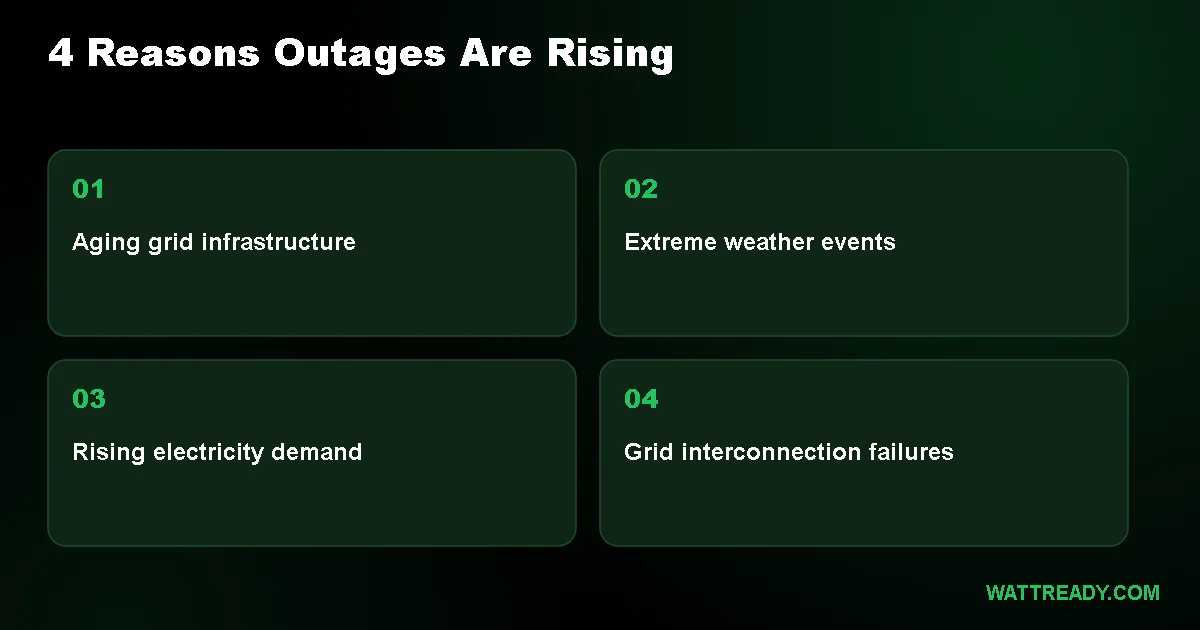
If it feels like power outages happen more often than they used to, that's not just perception — U.S. grid data backs it up. Multiple, compounding factors are behind the trend, and understanding them helps explain why backup power has shifted from a niche prepper concern to a mainstream household purchase.
1. An aging grid
A large share of U.S. transmission infrastructure was built decades ago and is now operating well past its originally planned lifespan. Aging transformers, substations and power lines fail more often and take longer to repair than modern equipment, and utility investment hasn't kept pace with the scale of what needs replacing nationwide.
2. More frequent and severe extreme weather
Hurricanes, winter storms, extreme heat events and wildfires are the leading cause of major outages, and their frequency and intensity have measurably increased over recent decades. Utilities in wildfire-prone areas (notably California) now also conduct deliberate Public Safety Power Shutoffs (PSPS) — proactively cutting power during high fire-risk conditions — which adds planned outages on top of storm-driven ones.
3. Rising electricity demand
Electric vehicle charging, data centers, home electrification (heat pumps, induction cooking) and general population growth are all pushing grid demand higher, straining a system that in many regions wasn't built with this level of load in mind — particularly during demand peaks like summer heat waves.
4. Grid interconnection and cascading failures
The U.S. grid is a highly interconnected system, which is efficient in normal conditions but means a large enough failure in one region can cascade and affect neighboring areas — a dynamic that has contributed to some of the largest blackouts in U.S. history.
What this means for your household
None of these trends are reversing quickly — grid modernization is a decades-long, capital-intensive undertaking, and extreme weather patterns aren't expected to ease. That's the practical case for household-level backup power: rather than waiting on infrastructure fixes with long timelines, sizing a power station or generator for your own essentials (see our free wattage calculator) is the lever an individual household can actually pull today.