

A power outage doesn't always mean your internet has to go down with it — if the outage is localized to your home (a tripped breaker, local line issue) rather than affecting the wider utility and ISP infrastructure, keeping your router and modem powered can keep you online for work, communication, or checking outage maps.
What it actually takes
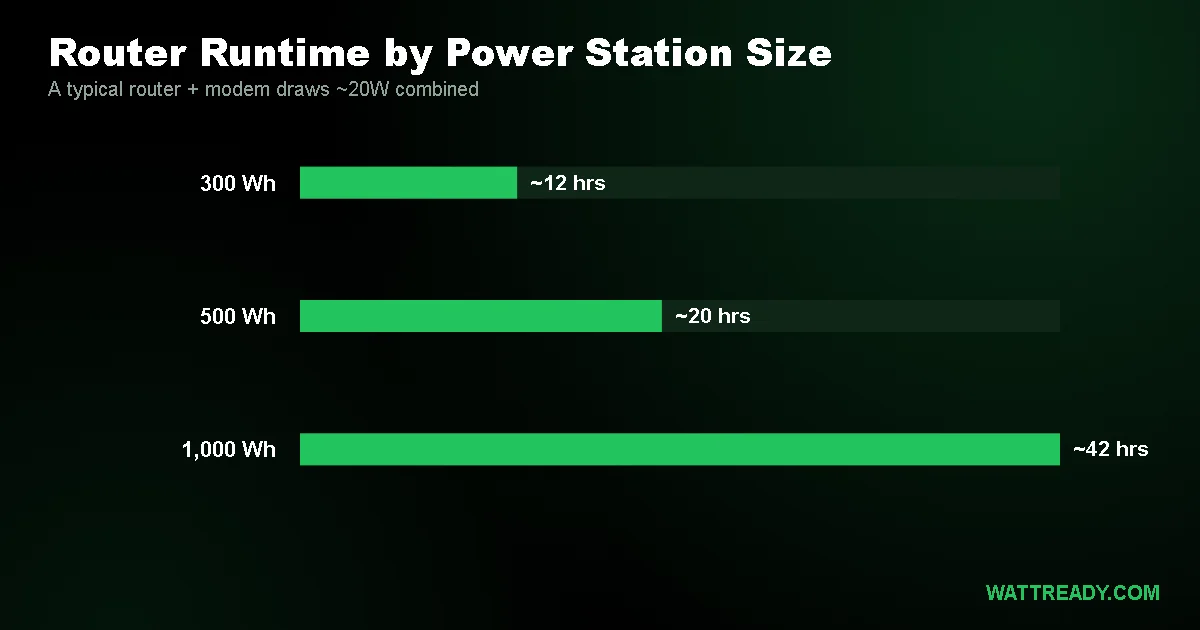
Routers and modems are some of the lightest loads in a home — combined, most setups draw just 15-25W, with no meaningful starting-watts spike. This makes them one of the easiest devices to keep running, and a small power station goes a very long way:
| Power station | Router + modem runtime (~20W combined) |
|---|---|
| 300 Wh | ~12 hours |
| 500 Wh | ~20 hours |
| 1,000 Wh | ~42 hours |
Even the smallest common power station capacity keeps a router running well over a full day — this is realistically the last item to worry about when sizing backup power, and a good one to add to almost any setup since it costs so little runtime budget. Add it to your full appliance list in our free wattage calculator alongside higher-priority items like a fridge.
The limits: when internet still won't work
Keeping your own equipment powered only helps if the rest of the chain is up. Internet access during an outage still depends on:
- Your ISP's local infrastructure — many neighborhood cable/fiber nodes have their own battery backup (often just 4-8 hours), but a prolonged outage can take the ISP's local equipment down regardless of your home setup
- Cell towers, if you're relying on a mobile hotspot instead — these also run on battery/generator backup with limited duration during extended outages
- Whether the outage is grid-wide or localized — a whole-region utility outage is far more likely to also affect ISP infrastructure than a single tripped breaker at your house
A practical backup internet plan
Keep your router and modem on a small power station (or even a basic UPS battery backup unit) for short outages, and treat a phone's mobile hotspot as your fallback if the outage is longer or wider — worth testing your phone plan's hotspot data allowance before you actually need it.