

Sizing a whole-house or portable generator is the same math as sizing a power station, scaled up — but the stakes for getting it wrong are higher: an undersized standby generator can nuisance-trip during every storm, while an oversized one costs thousands more than necessary in both purchase price and fuel.
Two sizing paths: whole-house vs. essential-circuits
Whole-house standby generators (installed permanently, running on natural gas or propane) are sized to cover your home's entire electrical panel — typically 14,000-22,000 watts for an average home with central AC. An electrician calculates this from your panel's total connected load, not a rough guess.
Portable generators (gas or dual-fuel, wheeled out and connected via a transfer switch or extension cords) are usually sized to cover a curated list of essential circuits — fridge, well pump, a few lights, the furnace blower — rather than the whole house. This is the more common and far cheaper approach for most homeowners, typically landing in the 3,500-7,500 watt range.
The starting-watts trap, again
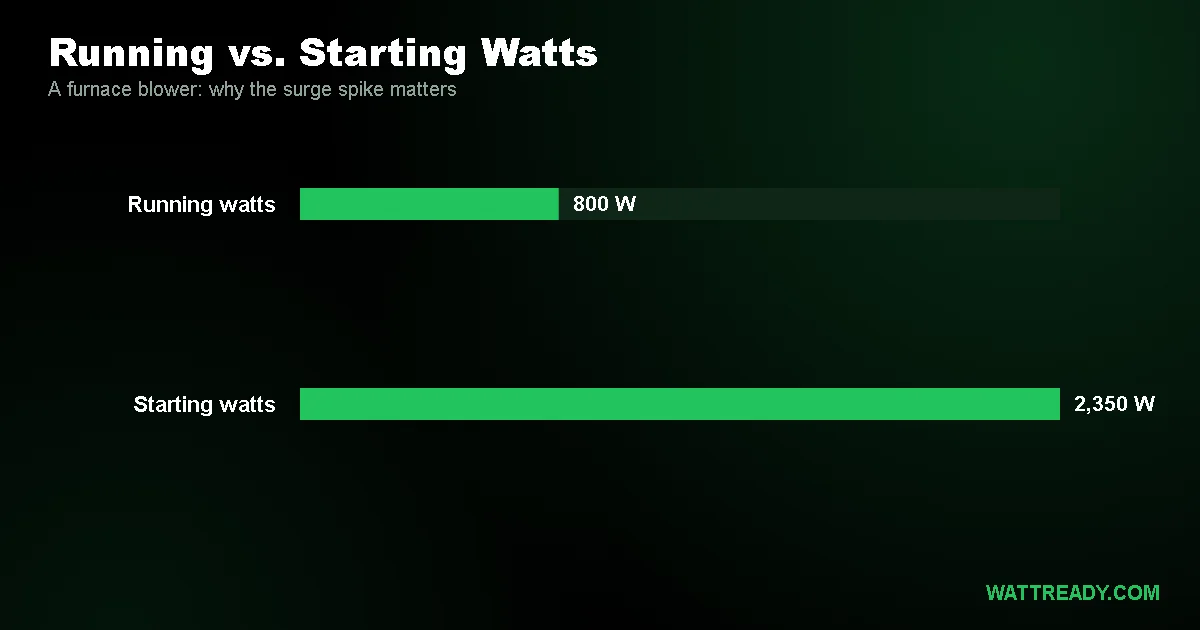
Generators fail the same way under-sized power stations do: the continuous rating covers your running total, but the starting watts of the single largest motor in your circuit list (a well pump, central AC compressor, or furnace blower) has to be covered on top of everything else already running. A furnace blower alone can spike to 2,350W starting from just 800W running — enough to stall a generator that only accounted for running totals.
Use our free wattage calculator to add up your essential circuits (it includes well pumps, furnace blowers, sump pumps and other common house loads) and get both the running and starting watts you need to shop against — the same numbers a generator's spec sheet lists.
Portable vs. standby: which do you need?
| Portable generator | Standby generator | |
|---|---|---|
| Typical cost (unit only) | $500-2,000 | $3,000-8,000 |
| Installed cost | $0-500 (transfer switch) | $5,000-15,000+ |
| Starts automatically | No — manual | Yes |
| Covers whole house | Rarely | Usually |
| Fuel | Gasoline / dual-fuel | Natural gas / propane |
For most households, a correctly-sized portable generator covering essential circuits is the more practical starting point — a whole-house standby unit is the upgrade once the budget and the outage frequency justify it.