

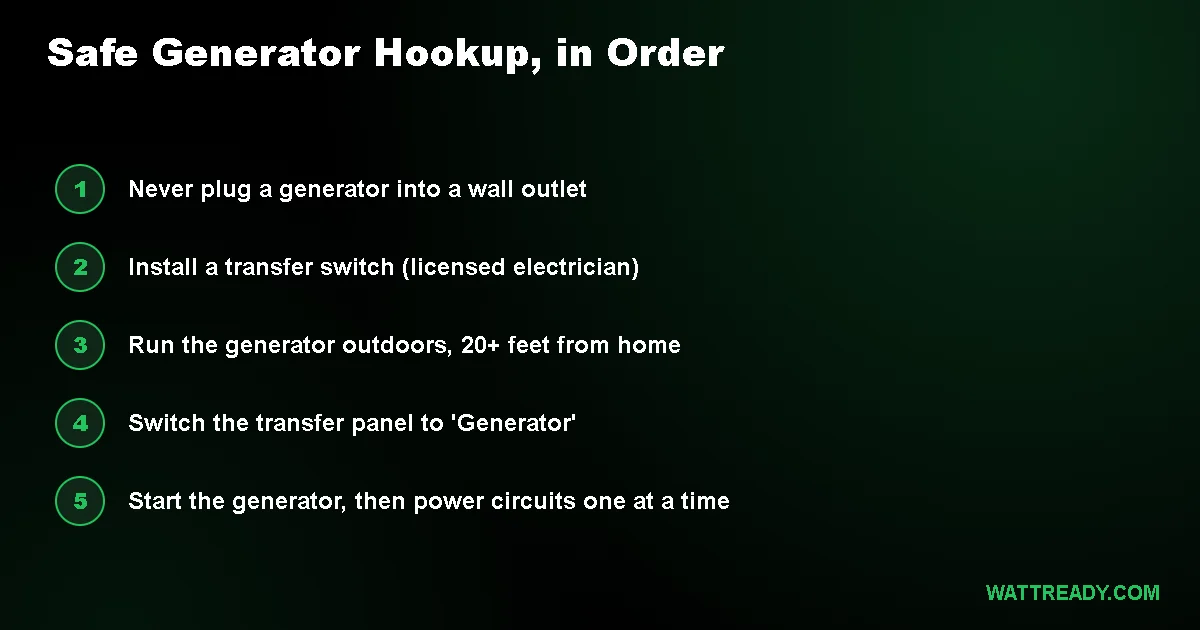
Every year, people are injured or killed by "backfeeding" — plugging a generator into a regular wall outlet to power the house through the existing wiring. It seems like a shortcut. It's actually one of the most dangerous mistakes in home generator use, for reasons that aren't obvious until you understand how the grid works.
Why backfeeding is dangerous
When you backfeed a generator through a wall outlet, electricity flows backward through your home's wiring and out through the meter onto the utility line outside — the same line utility crews may be working on during an outage, believing it's dead. This can seriously injure or kill a lineworker who has no way of knowing your generator is energizing what should be a de-energized line. It's illegal in most jurisdictions for exactly this reason, on top of the fire and equipment-damage risk to your own home's wiring.
What a transfer switch actually does
A transfer switch is installed between your generator, your electrical panel, and the utility connection. It physically ensures only one power source — the grid or the generator — can be connected to your home's wiring at any moment, making backfeeding impossible by design rather than relying on you to remember not to do it.
| Type | How it works | Typical cost (installed) |
|---|---|---|
| Manual transfer switch | You flip switches for each circuit you want powered | $500 - $1,500 |
| Automatic transfer switch (ATS) | Detects an outage and switches over automatically, no action needed | $1,000 - $3,000 |
The correct hookup sequence
- Position the generator outdoors, at least 20 feet from the house, pointed away from windows and doors — see our carbon monoxide safety guide for why this matters.
- Connect the generator to the transfer switch inlet using the appropriate cord (this is typically the only cord you'll touch — no extension cords into the house).
- Start the generator and let it stabilize for a minute before adding load.
- Switch the transfer panel to "Generator" mode (automatic units do this without your input).
- Turn on circuits one at a time, largest loads last, to avoid a large simultaneous starting-watts spike — size your total load first with our free wattage calculator.
For portable generators without a full transfer switch
If a full panel transfer switch isn't in the budget yet, an "interlock kit" (a simpler, code-compliant mechanical device that prevents the main breaker and generator breaker from being on simultaneously) is a lower-cost licensed-electrician install that still eliminates the backfeed risk — far preferable to running extension cords to individual appliances, which works for a handful of small loads but doesn't scale to a fridge or furnace safely.