

"Worth it" depends entirely on what you're comparing against — a power station's return on investment looks very different if you're replacing a gas generator versus buying backup power for the first time versus comparing it to simply eating the cost of ruined groceries every outage.
What you're actually paying for
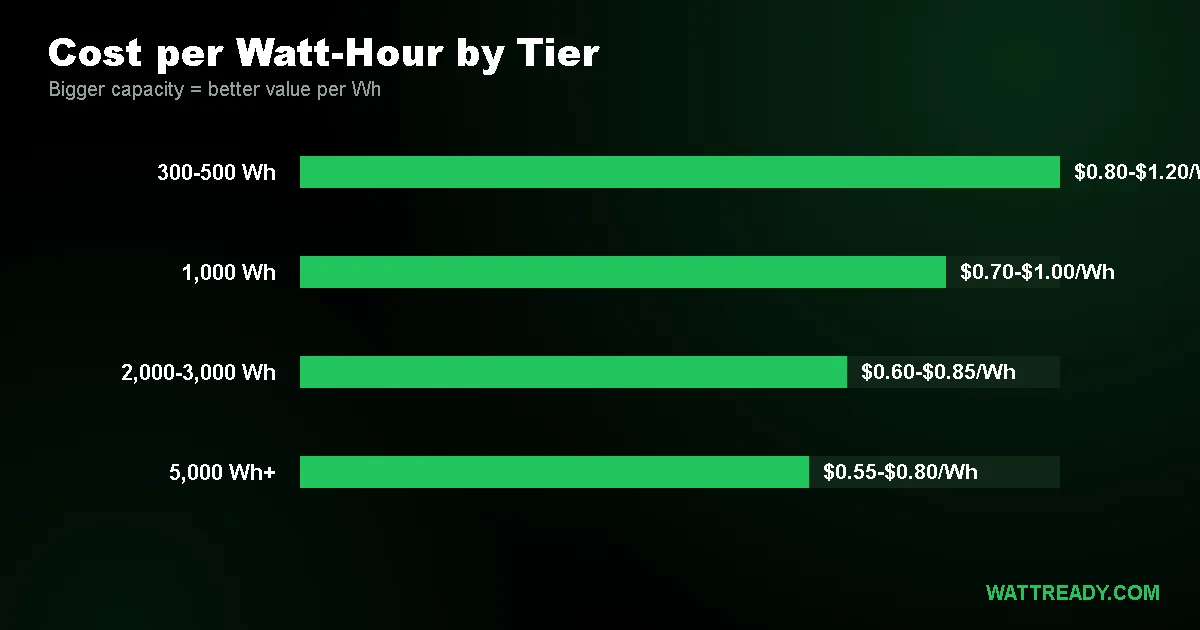
| Capacity tier | Typical price | Cost per Wh |
|---|---|---|
| 300-500 Wh | $250-$500 | $0.80-$1.20/Wh |
| 1,000 Wh | $700-$1,200 | $0.70-$1.00/Wh |
| 2,000-3,000 Wh | $1,500-$3,000 | $0.60-$0.85/Wh |
| 5,000 Wh+ | $3,500-$6,000+ | $0.55-$0.80/Wh |
Cost-per-Wh generally improves at higher capacities, which is why sizing correctly (rather than buying small and stacking multiple units) is usually the more economical path once your calculated need crosses into the 1,000Wh+ range — see our free wattage calculator to find your real number before comparing prices.
Where the ROI is clearest
- Frequent short outages (multiple times a year): avoided spoiled groceries alone ($150-$400 per full fridge/freezer loss) can offset a meaningful chunk of the purchase price within 1-3 outages.
- Medical necessity (CPAP, oxygen, refrigerated medication): the value here isn't really financial — it's risk elimination, which is difficult to price but easy to justify.
- Replacing a gas generator's ongoing costs: no fuel purchases, no oil changes, no engine maintenance — a power station's "fuel cost" is just your electricity bill to recharge it, a few cents per full charge.
- Dual-use with camping/van life: if it also replaces a separate camping power solution, the cost is effectively shared across two use cases.
Where the math is less favorable
If you need to cover large loads (central AC, an electric dryer, a well pump) for extended multi-day outages, the capacity required gets expensive fast compared to a fuel generator's cost per watt at scale — this is the scenario where a generator often wins on pure cost-per-watt, even though it carries fuel, maintenance and CO-safety considerations a power station doesn't.
For most households sizing realistic essentials — fridge, Wi-Fi, some lights, phone charging, maybe a CPAP — a correctly-sized power station is genuinely good value: no recurring cost, no maintenance, silent, safe indoors, and it holds most of its usefulness for a decade or more.